
Review: Bajaj Pulsar NS125 review, road test
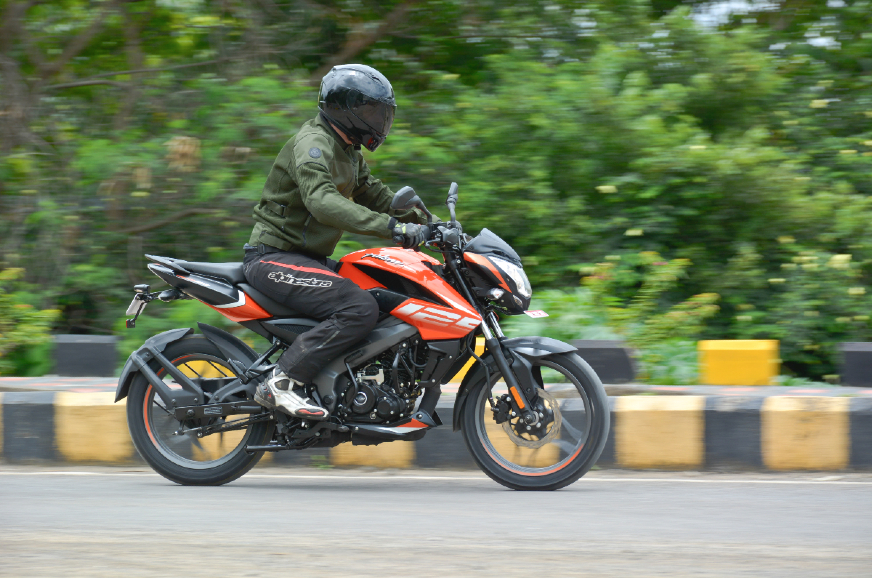
Bajaj has taken its successful Pulsar NS formula and applied it to the 125cc segment, borrowing the engine from the regular Pulsar 125 and housing it in the perimeter frame from the bigger NS models. It sits somewhere between the true-blue commuters, and the sporty KTMs of the 125cc world, both in terms of specs as well as price. Can it amalgamate the riding thrills of the latter with the value-for-money of the former? Let's find out.
Where the Pulsar NS125 falls short in brochure-filling features, it makes up in competent underpinnings. At under Rs 1 lakh (ex-showroom, Delhi), Bajaj is giving you respectable hardware in the form of a perimeter frame and a preload-adjustable monoshock, just like on the larger NS models. As a result, handling is rather sweet, and the NS is a fun bike to throw around corners. The skinny tyres might not do much for the looks, but they make the NS125 feel lighter on its feet than the slightly heavy-steering NS200. Sure, it isn’t the most communicative thoroughbred corner-carver, but once tipped in with minimal effort, the bike feels steady enough and inspires a fair amount of confidence.

That’s the sportiness side taken care of. The sensibility aspect comes from the good ride quality and large dimensions. The telescopic fork does a great job of isolating you from our less-than-perfect roads, though the monoshock can feel a little on the firmer side, even at its lower preload settings. Nevertheless, ride quality overall is quite comfortable, as is the seating position.
Sharing its underpinnings with the NS200 not only gives the 125 fun handling characteristics, but also generous proportions that are well suited to similarly generously proportioned riders. The 1,353mm wheelbase is longer than even that of the Pulsar 150, and taller riders will find the rider’s triangle pleasantly roomy, with a good reach to the bars and enough seat-to-footpeg distance. The only real chink in the NS’ armour in the comfort department is a seat that can become slightly uncomfortable over longer durations –an issue that’s amplified by the slightly stiff rear shock absorber.
At 144kg, the NS125 is a good 20 to 30kg heavier than traditional 125cc commuters, but a well-balanced chassis means that you don’t really feel this once you’re on the move. Even at a standstill, the weight is quite manageable, and it’s only 4kg heavier than the standard Pulsar 125, which is commendable. Lighter cycle parts and a smaller, lighter engine also mean that it’s 7kg lighter than the NS160 and 12kg lighter than the NS200.
The theme of middle ground extends to seat height as well, where the Pulsar’s 810mm figure lies almost exactly in between commuters like the Honda Shine (791mm) and more focused bikes like the KTM 125 Duke (830mm).

The NS’ performance in the ‘stop’ department is similar to its performance in the ‘go’ department. On paper, it only gets a small 240mm disc brake up front. There’s no disc of any kind at the rear, and you have to make do with a 130mm drum brake instead. Nevertheless, the real-world performance is up to the mark, and the setup does a decent job of bringing the bike to a stop. The only room for improvement is a little more feel at the lever, and the addition of an ABS system –although Bajaj would point out that that would take the price well above the Rs 1 lakh mark, which has significant psychological ramifications for a 125cc motorcycle.

The final piece of the puzzle is the price tag. The exact amount is Rs 98,234 (ex-showroom, Delhi), which places it almost exactly on par with the Pulsar 150 Neon. For reference, it’s about Rs 20,000 more expensive than the regular Pulsar 125, while the KTM 125 Duke is a whole Rs 72,000 more than the NS125. With this context in mind, the Pulsar NS125 certainly carries a premium price, but it also delivers a distinct and unique experience in the 125cc segment, one with a strong Pulsar flavour to it. It has superior dynamics to both, the Pulsar 125 and the Pulsar 150 Neon and it also looks and feels a whole lot more modern than those two. All this while remaining considerably more affordable than its Austrian counterparts. It seems that Bajaj has found an enticing middle ground, and by doing so, the company is further exploring uncharted territory in the 125cc segment.
![PM Modi’s car convoy is more EXPENSIVE than Ambani’s [Video]](https://lh3.googleusercontent.com/blogger_img_proxy/AEn0k_uDoKlUJZcBXbEHbRBNSfosIZXH69N9uyyU3y2r-tbVBy5gIzpII201joPUCi9hdQ0sfJ09OfG1BtzlOc0zyhqoReejj40VfegcOOeTgfYTyfo)
No comments
please do not enter any spam link in the comment box